Return to Community Capitalism - Part 3
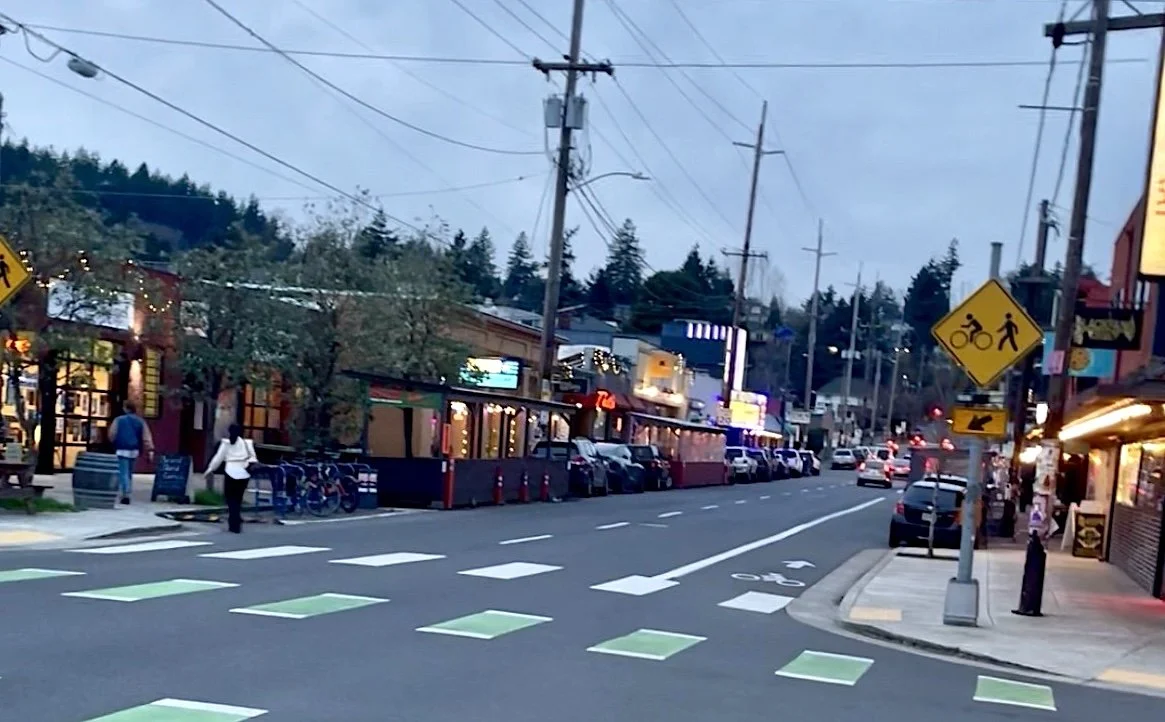
This is the final article about the need to develop public policies based on community capitalism. In the first article, I discussed the problem. In the second article, I offered an alternative set of short term public policy priorities and in this article, I am proposing three longer term policies to build community capitalism.
The concept of community capitalism is not new. Back in the 1960s most communities were built on a strong main street supported by one or more industries. Community capitalism was dismantled as cities, states, and the federal government created a public policy environment where large multinational corporations gained advantage over small local business owners. Decades later, many communities have been hollowed out by years of extractive (and often predatory) capitalism. Industries have been consolidated, relocated or operate at a fraction of previous capacity. Main street has been replaced by one-click shopping. The pathway forward is to reclaim local power, for example, by investing in local businesses. This alone will fight corporate extraction of wealth. One just needs to do a cursory read about the small business multiplier to understand that on average, 48% of each purchase at an independent small businesses is recirculated locally, compared to less than 14% of purchases at chain stores (1).
It does not take a degree in economics to understand that the interests of corporate shareholders work directly against building local wealth. Yet, somehow, under the conservative era of of the late 70s and early 80s, corporations were able to convince political leaders that with the birth of globalization, “there is no alternative” to ceding to the public policy demands of corporate capitalism. What is baffling, in a city that is branded as progressive, is how many elected politicians line up to incentivize corporate interests over community interests.
As I stated in the previous articles of this series that the unrealized potential of the city council restructuring in 2022, is the potential for public policies to reflect and benefit the city equally across districts but currently economic policies fall way short of that potential. Unfortunately, I think that rank choice voting elevated political candidates to elected positions whose grasp of small business realities is insufficient for the moment we are in. As a result, the councilors’ economic policies, by and large, still represent corporate monied interests rather than the small business needs of the districts that they represent. (Sidebar: In my opinion, the funding of the James Beard Market and the proposed business license tax exemption increase are the exceptions). If the Portland City Council and Mayor were serious about creating community capital, they would revise their economic policy investments to build local neighborhood business economies as I outlined in my last article. However to build the long-term resiliency of community capitalism, I would suggest three longer term policy proposals.
Reform City Procurement to Advantage Small and Micro Businesses One critical way to support community capitalism is to reengineer city procurement to advantage local suppliers. In the most emblematic of examples, is that in 2023, the city of Portland amended its price agreement with the world’s largest and predatory company, Amazon and now spends $2,250,000 for its products. This nearly doubled the amount previously spent (2). This one price agreement diverts $2.2 million from the community and does even more harm.
According to a recent study, Amazon’s government contracting practices drives up costs for governments, has little transparency, and erodes competition by pushing out better-performing, more accountable independent suppliers. The report concludes that “The disappearance of these small and mid-sized businesses weakens local economies and tax bases. And it leaves governments increasingly dependent on Amazon, paving the way for the kind of monopoly control that ensures higher prices, poorer service, and less innovation” (3).
Eliminating the price agreement with Amazon would immediately infuse capital into our local economy and strengthen local small businesses.
Beyond the Amazon example, the City of Portland needs to adopt transparent and measurable goals specific to small business contracting and create specific small business procurement set-asides —beyond the token bonus-point system for certified MWESB(V) businesses. In addition, the city must redesign the byzantine procurement contracting process which creates entry barriers to local small businesses seeking to do business with the city. A fully resourced Office of Small Business to adequately support small businesses is needed to aid in this transition process.
Adopt Formula Retail Restrictions. To encourage the development of community capitalism, the city of Portland should use Formula Retail restrictions as a zoning tool to limit the proliferation of formula businesses (standardized chains). Such ordinances help to preserve the local character of business districts and protect small businesses from unfair advantages that come from national chains. As an example, data suggests an average Starbucks location generates approximately $1.2 million in annual revenue. Using the local multiplier rule of thumb, a mere $168,000 (14%) of the Starbucks revenue recirculates in the local economy. If that Starbucks was zoned out of the business district, a locally owned coffee shop with the same revenue profile would circulate $560,000 (48%) in the local economy. Formula Retail Restrictions have been used for years by a growing number of cities and towns to restrict stores and restaurants that have standardized services, décor, methods of operation, and other features that make them virtually identical to businesses elsewhere (3). In fact, here in Oregon the Joseph City Council passed a measure in 2024 barring ‘formula’ stores. If a fragile rural community can see the economics of zoning out predatory chain stores, surely progressive Portland leaders can rally behind the concept of leveling the business playing field to create community capitalism and inspire entrepreneurism.
Create a Municipal Public Bank According to the Public Banking Institute, “17% of banks around the world are publicly owned with assets just under $49 trillion. The U.S. is far behind, with only one state-owned bank, one in a U.S. Territory, and several Indigenous tribal banks.” Yet the concept of public banking is a very simple idea at its core. In contrast to large regional and national publicly traded banks, whose mandate is to operate in a way to maximize profits for their shareholders, owners, and executives,” publicly-owned banks are “legally obligated to operate in the interest of the public, meaning the community as a whole. That means their investment decisions are focused on growing the real, wealth-producing local economy, not the latest speculative scheme to boost private shareholder profits and executive bonuses” (5).
According to one study of a prospective public bank it was determined that a publicly owned financial institution through direct financing and partnership lending with community-based financial institutions, would: 1) increase credit availability for small businesses not well-served by large commercial banks; 2) boost affordable housing and local renewable energy; and 3) expand the capacity of the city’s small banks and credit unions to the community (6).
Unfortunately, at the state level, in 2023, House Bill 2763 to establish an Oregon State Public Bank Task Force, a legislative initiative that would have studied and made recommendations for the establishment of a state-owned public bank. The democrat sponsored measure passed both chambers but was vetoed by Governor Kotek.
In the absence of state leadership, the concept of developing a local municipal bank is an idea that seems ideal for Portland’s elected leaders to champion as a way to build community capital. According to the Oregon Public Banking Alliance, a public bank would stretch “our tax dollars by reducing the cost of financing projects by as much as half, leaving more money available for other public services and reducing the overall tax burden of the people” (7).
As I have disclaimed before, the ideas presented in this series of articles are not fully formed policy statements but a set of progressive public policy ideas, each with an economic evidence-base. They are long-term and I am under no illusion that any would be easy to accomplish. However, if there was political will to see the policies adopted, these policies would allow the city of Portland to break the chokehold of predatory and extractive capitalism. We need elected officials willing to fight for pragmatic ways to support small and micro businesses across the 50 business districts with a long term vision. A progressive agenda builds local economic resiliency and is the alternative that is hidden from view in the rhetoric of “there is no alternative” trickle down economics currently being championed by the mayor and the city council.
References
(1) Risley, J. (2025b, October 12). The local multiplier effect. AMIBA.
(2) City of Portland Ordinance 191406 Amendment.
(3) Mitchell, S., Smith, K., Holmberg, S., & Mohamed N. (2025, December). Turning Public Money into Amazon’s Profits: The Hidden Cost of Ceding Government: Procurement to a Monopoly Gatekeeper. Institute for Local Self-Reliance.
(4) Stumo-Langer N (2018, January 26) Bloomberg Businessweek Profiles Cities that Restrict Chains to Free More Space for Local Businesses. Institute for Local Self-Reliance.
(5) McInally, M. (2024, June 15). Joseph council passes measure barring “formula” stores. East Oregonian.
(6) Public Banking Institute. (n.d.). Public banks 101.
(7) Parrott, J., & Mattingly, M. (2023, June). The economic impact of a New York City Public Bank. Center for New York City Affairs.
I have over 30 years of experience in community development and helping organizations weave social fabric and improve communities. In roles as diverse as a nonprofit executive director, interim director and a consultant, I helped dozens of organizations in the Portland Metro area to run effective meetings, assess community needs, design programs, create effective boards, develop strategic plans, and strengthen programs that serve the community,
