Return to Community Capitalism - Part 2
This is the second in a series of three articles about the need to develop public policies based on community capitalism. In the last article, I discussed the problem. In this second article, lay out an alternative set of short term public policy priorities and in the third article, I will propose a vision for longer term change.
As I outlined in the last article, it is my opinion that Portland has created an environment where our elected leaders have allowed monied business interests to paint them into a corner. The thinking is that “there is no alternative” other than supporting predatory corporations and billionaires. Our economic success, it is argued, is dependent on subsidizing large corporations, shifting social and infrastructure burden from corporations to taxpayers, and reducing big business corporate regulatory and tax barriers. In other words, our leaders are perpetuating the local equivalent of Reaganomics even though the consensus is that trickle down economics do not work (1).
In this article, I would like to discuss an alternative set of short term public policy priorities, illustrating this vision using the mythical $600 million of taxpayer money the city has identified to renovate the Moda Center. —side note: add a user tax to every Moda center ticket purchased and increase the cost of advertising, concessions,sky boxes, and suites to pay for the “needed” renovations.
Let’s start with the basics. Portland is roughly a city of 636,000 residents, spread across 90+ distinct neighborhoods and supported by ~50 unique business districts. As a reminder, in 2022, the Portland city charter was revised to expand the city council to 12 members. The purpose was to create three elected members for each of four new geographic districts to ensure diverse localized representation. With this in mind, you would expect our economic public policies to reflect a distributed approach rather than concentrating resources in the downtown core. But here we are.
So, let’s re-imagine how to build community capitalism if we indeed had $600 million to invest in local economic development rather than cosmetic upgrades to a sports arena. Simply dividing the $600 million by the 50 business districts of Portland would create $12 million for each business district that could be invested in four strategies.
1) Subsidize or eliminate unnecessary fees for micro and small businesses.
Most small businesses are bootstrapped and at startup face a myriad of small to large fees for permits ranging from the insignificant cost of mandated bathroom signage, to permit fees associated with hanging a business sign (over $200) or sidewalk sandwich board signage (about $100). If you are a restaurant wanting to provide curbside covered seating, you face over $1,000 for the application and permit and $1000 annual fee per parking space that is displaced —as well as scores of other related permitting city expenses. With $12 million per business district, let’s use a small portion to subsidize these costs to cash strapped start ups to encourage entrepreneurship.
2) Create, fund, and implement business district plans to improve public spaces, walkability, safety, curb appeal, and other locally identified business priorities.
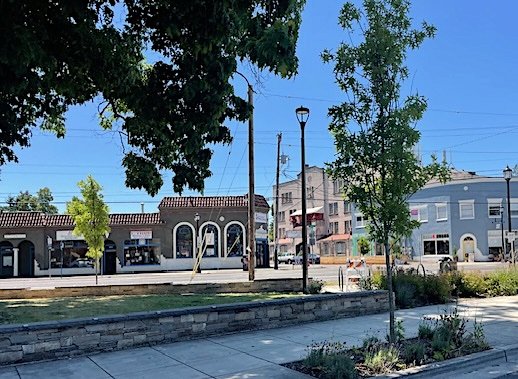
Transportation, parks, public safety, development, economic development and sustainability, are all siloed functions in the city. The second strategy is to start thinking from a systems perspective about neighborhood business districts with a focus on placemaking. Invest in the development of business district improvement plans that require cross silo coordination of existing city programs to systematically improve business districts. Again with $12 million per business district of capital at play, this strategy would leverage district business funds with bureau-allocated resources. Coordinated planning would result in systemic improvements that strengthen the social cohesion of the community, generate foot traffic and improve the economic base of neighborhood business districts.
3) Provide incentives for job creation and short-term subsidies for increasing wages and benefits.
We have grown numb to the state and local municipalities doling out large incentive packages to attract big businesses to locate in our region and state even though the data does not support a return on investment —in terms of jobs created and the stability of jobs that are created (2). This conclusion about large corporate subsidies is echoed across the political spectrum from the conservative CATO Institute (3) to the more liberal Center for American Progress (4).
But at the neighborhood level small incentives would allow micro and small businesses to grow. When you look at the statistics for small businesses in the US, 80% operate without any employees and the next 16% of small businesses have between one and 19 employees. So helping these businesses add one or two staff would be game changing. For example, we could create incentives modeled after the Oregon Business Expansion Program (BEP). The BEP requires adding 50 staff to companies with at 150 employees but creating a local program at a micro-hiring level (say 1-10 employees) would give small businesses the ability to scale and grow revenues to sustainably support the new jobs. Another way to incentivize local job creation is to give local tax credits to help small businesses close the gap between minimum and living wages. Imagine these two approaches creating new jobs in each business district, on an annual basis. Even 20 new jobs per district would result in 1,000 new jobs at a living wages every year. This would bring greater economic stability and equity across all 50 business districts.
4) Create a revolving loan fund for small businesses to incentivize micro and small scale manufacturing, support business operations and local commercial real estate ownership.
I know that the city has several small business loan and grant programs already. Unfortunately the collective amount of funds available are small, the application process is byzantine, narrowly defined, and the decision making is often opaque. Many neighborhood businesses invest a lot of work trying to access these programs only to be told there are insufficient funds available. With $12 million per business district, access to three types of capital would increase.
The first capital need is for debt consolidation for businesses that are not yet “bank ready.” A recent study documents the outsized role of credit cards as a funding stream to support early stages small businesses. According to the study “between 2021 and 2023, credit card usage nearly doubled, interest payments surged, and delinquencies rose.” The research also points out that credit card payments are typically three times as high as conventional loan payments (6). I spoke with a business owner recently who shared that if they could shift their credit card balances to a conventional loan, it would cut their monthly interest in half and they would immediately hire another half time employee. This business has a track record of on time payments but their revenues are not yet “bank ready.”
The second capital need is for down payment assistance for businesses to purchase their retail location. It is not uncommon for retail stores to pay well over a third to one half of their monthly revenue on occupancy costs, paid to an out of state landlord. With the equivalent of a first time homebuyer loan program supporting a down payment on a retail space purchase, such loans would build local wealth and give a small business an asset that could be leveraged for future self-sufficiency.
The third type of capital investment needed is for business expansion. Portland neighborhoods are home to combined maker and retail spaces. For example, growing makers —like a fabric decor business, candle maker, food product, or studio pottery shop are the new domestic manufacturing agenda at the micro and small business level. Expanding “manufacturing” enterprises adds jobs and diversifies our local economic base and spreads the capital risk and reward across the entire community (7). Again, we can acknowledge a patchwork of organizations helping micro-businesses grow but dedicated resources across all business districts can scale these fragmented efforts.
Let me be clear, the four ideas that I am recommending are not to be construed as fully developed policy positions but each have an economic evidence base as ways to strengthen our community capitalism. I am arguing for a neighborhood economic development approach that is consistent with the goals of equity and representation that are at the core of the 2022 Charter reform passed by Portland voters. For the first elected city council under this reform to propose a massive corporate subsidy that benefits a small geographic slice of Portland and caters to those with the privilege and means to purchase professional sports and concert tickets is mind boggling.
The purpose of this article is to challenge the notion that “There Is No Alternative” to economic development other than to prop up the broken system of predatory capitalism that widens the wealth gap at the expense of taxpayers. Shifting public investments from corporate capitalism to community capitalism is possible but, in Portland at this moment in time, it requires our elected officials to put the neighborhoods and districts they were elected to represent ahead of the basketball ticket perks that come with their job.
In the final article in this series, I will advance three larger policy frames for building community capitalism. Stay tuned.
References
(1) Shuman, M. (2015). The local economy solution: how innovative, self-financing "pollinator" enterprises can grow jobs and prosperity. Chelsea Green Publishing.
(2) Rogoway, M. (2023, February 27). Oregon Tax Breaks to Big Tech Not Always Beneficial Governing Magazine
(3) Edward’s, C. (2022). Special Interests and Corporate Welfare. CATO Institute.
(4) Schwartz, A. (2018, November 1) The Realities of Economic Development Subsidies. Center for American Progress.
(5) Main, K .(2026, February 2) Top Small Business Statistics – Forbes Advisor Forbes
(6) Akcigit, A., Chhina, RS., Cilasun, S., Miranda, J., & Serrano-Velarde, N. (2025, April 23). Credit Card Entrepreneurs. Becker Friedman Institute for Economics.
(7) Preuss, I. (2021) Recast your city: How to save your down-town with small-scale manufacturing. Island Press.
I have over 30 years of experience in community development and helping organizations weave social fabric and improve communities. In roles as diverse as a nonprofit executive director, interim director and a consultant, I helped dozens of organizations in the Portland Metro area to run effective meetings, assess community needs, design programs, create effective boards, develop strategic plans, and strengthen programs that serve the community
