Portland Needs a Small Business Strategy
Here in Portland, Oregon, the continued swirling controversy around the Moda Center negotiations is sucking all of the political energy out of the room. Meanwhile, the real needs of small businesses across our city continue to accumulate at an alarming pace. Whether it is the largely ignored story of how private equity is quietly gutting local ownership – and in the case of Schoolhouse, destroyed a small business icon (1), the string of restaurant and bar closures this spring (2), or the reported 66 confirmed retail closures from national chains to over 50 independent local businesses (3), the message is clear, Portland needs a small business strategy. Yet, instead of a strategy, we get table scraps swept from the public policy table. Most recently, the mayor announced a new Vacant Storefront Grant Program (4).
While the Vacant Storefront Grant Program is only one of several grant opportunities offered by Prosper Portland, it is emblematic of the core city problem of throwing money at programs that sound good and have a high public relations value but little lasting impact. Let’s start by considering that this is a one time funded grant program with a total allocation of $800,000. This grant offers new businesses signing a three-year lease access to financial resources for space renovation and building improvements.
The Vacant Storefronts grant is not being represented as a pilot that, if successful, will be replicated and expanded in future years, nor is it intentionally connected to the Prosper Portland Strategic plan adopted in 2023 (5). To be clear, the Vacant Storefront program is an orphan program to be swapped out at the next whim of the Mayor or City Council.
Let’s break this grant down a little further. Our city is divided into four political districts with a total of 50 distinct economic corridors. The money available to address vacant storefronts is $200,000 per political district (if distributed equally) but only $4,000 per economic district. With grants ranging $25,000-100,000, if the average grant is at the mid-point of funding we might see the launch of 21 new businesses against the year-to-date closure of 51 independent local businesses. That’s a lot of happy ribbon cutting ceremonies if we ignore that two businesses go under for every new one that opens.
Let’s also be blunt and talk about what this program does and does not achieve. As noted, this grant opportunity is designed for the hard costs and associated planning support for the improvements of commercial, industrial, and mixed-use property. Not owner equipment, signage, any other start up cost, just building improvements for the landlord.
Technically, the grant does provide capital to the business owner but the long-term benefits of the improvements go to the property owner. If the new business fails, it is the building owner who reaps the benefits of the renovated space and can pass that value on to the next tenant as higher rent costs. Is that a crass way of looking at this? Perhaps, but given that data suggests one in five businesses fail within the first year and nearly half of all businesses shut their doors by the fifth year, this incentive program becomes a significant landlord subsidy.
If this grant program was connected to a small business strategy rather than a political strategy it would never be so overtly simplistic. Don’t get me wrong, I know many entrepreneurs that would benefit immensely from the cash offered in this grant. The problem is in the details —or lack of details—in this program.
In reviewing the documents provided by the city, it is clear that this grant does not require the funded business to demonstrate the strength of their business model, financial capital to run the business, nor business owner experience or competencies. This is not a strategic small business program but is the equivalent of a lottery ticket for both sides. Applicants stand in line hoping that they are among the first come - first served, and the city is blindly hoping that those first in line are competent to run a business in the long-term. And without a transparent grant review process consisting of a competent evaluation panel, this program becomes just one more political tool awarded to political “public relations worthy” projects. — for example, mark my words, the politically hot Parkrose Grocery store will be a grantee.
If this program misses the mark, let’s be clear about the elements of small business strategy that is needed in Portland at this moment.
Infrastructure Focus - A citywide small business strategy begins with thinking about the systems and ecology and rather the current small business policy of funding discrete initiatives. We do not need sound bite policies but the ability to think systemically. I am not the only one writing about this. For example, last May, local small business advocate Sarah Shaoul, of Bricks Need Mortar, eloquently laid out a series of nine policy recommendations for the city to consider as an alternative to the misguided Vacant Storefront Grant Program (6). I recommend reading Sarah’s article (link here). Other consulting groups and business incubators bring even more ideas to the table. However, until the city embraces opinions other than its own, we will continue to get random rather than systemic solutions.
Business District Focus - A Portland strategy for small businesses needs to be anchored to the approximately fifty business districts of Portland. While every business district shares common needs of public spaces, walkability, safety and cleanliness, each retail corridor in the city is diverse hyperlocal business ecology. Once we step outside the tourist guidebook neighborhoods, our business corridors are marked by unique characteristics and needs. Filling stores just to fill them makes little sense when neighborhoods are working to create retail themes. The goal should not be occupancy but economic ecology. What kind of business will build and reinforce economic collaboration. Thinking about city policy as the sum total of neighborhood policies, is an approach Atlanta is taking and we should adapt a similar philosophy (7).
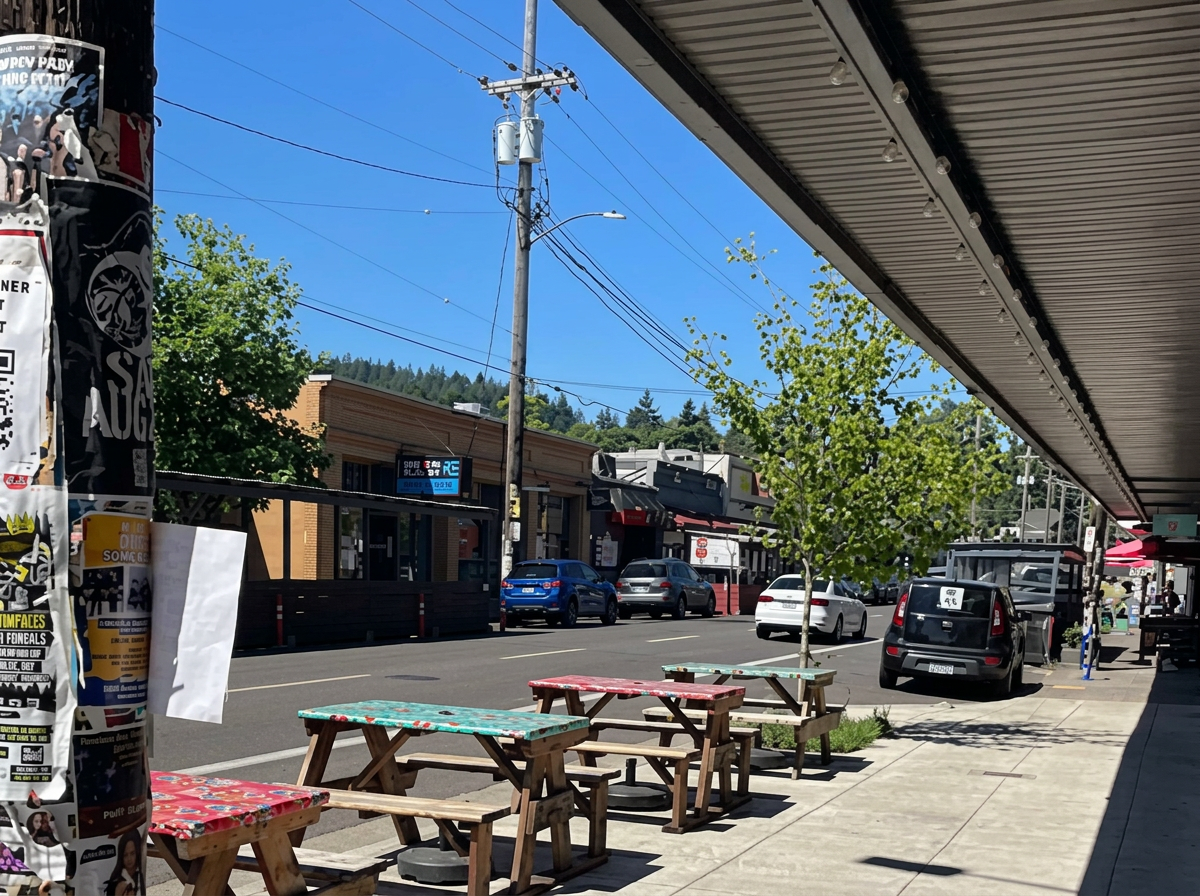
Neighborhood Destination Focus - Business Districts need anchors or destinations that support the community focus of neighborhoods. A small business strategy that invests in destination anchors is worth more than a random program to fill a handful of empty storefronts. One critical anchor is a Farmers Market. For many neighborhoods, such markets provide social cohesion, food access, and economic development and drive foot traffic to nearby businesses. Food cart pods and curbside seating for restaurants offer a similar social anchor for a neighborhood economy. Maker spaces also provide community building. A small business strategy would invest strategically in neighborhood destinations through a combination of eliminating annual fees for things like curbside seating, adding more public spaces and providing strategic capital to strengthen anchor destinations. Pedestrian count outside the urban core is as important, if not more so, than pedestrian traffic in the city core.
Asset Ownership Focus - I recently was talking to a business owner, who after 13 years in business —successfully navigating COVID, is now facing an uncertain future because the building landlord is threatening to jack up rent. Not by a little but by a lot. So, instead of throwing capital to landlords via untested startups, a Small Business strategy must foster local ownership of buildings. For businesses that have a proven track record of success, a $25,000-$100,000 grant would be a critical vehicle to helping successful business owners purchase buildings rather than pay absentee landlords (8). This would circulate more dollars locally and build economic resiliency.
Coming back to the shortcoming of the Vacant Storefront Grant Program, the program lacks strategy and systems-thinking. Honestly, for every under-capitalized start-up retail space applying for this grant there are several mature established businesses facing rent hikes, inventory cost and staffing challenges that threaten to push them over the edge of insolvency. We need to change the conversation.
So where do we go from here? I’d start with Council members convening true small business advisory groups at the political district level and convene the groups to educate our elected representatives and make systemic policy recommendations at the district level. That’s collaborative governance.
References
(1) Alpert, Y. (Mar 30, 2026) Schoolhouse Rocked: How a Private Equity Playbook Bankrupted a Beloved Home Goods Brand, INC Magazine.
(2) Russell, M. (Updated: Jul. 03, 2026, 11:30 a.m) These 10 Portland restaurants and bars have closed in the past two months. What gives?, Oregonian.
(3) Store Closure Watch (Online Access) Retail Store Closures in Portland — August 2026
(4) Prosper Portland. Vacant Storefront Grant Program.
(5) Portland City Council (April,2023) Advance Portland: A Call to Action for Inclusive Economic Growth. Prosper Portland
(6) Shaoul, S. (May 4, 2026). Portland's Commercial Vacancy Crisis: What City Hall Gets Wrong - and What to Do Instead. Bricks Need Mortar.
(7) Kaplan, S (August 18, 2026). How Siloed Governance Is Creating a Fiscal Crisis for Cities. Flourishing Neighborhoods.
(8) Ho, J (December 4, 2024) For small businesses, owning a building can provide stability in uncertain times
